Best Homeowners Insurance in the USA in 2026 — Complete Explanation
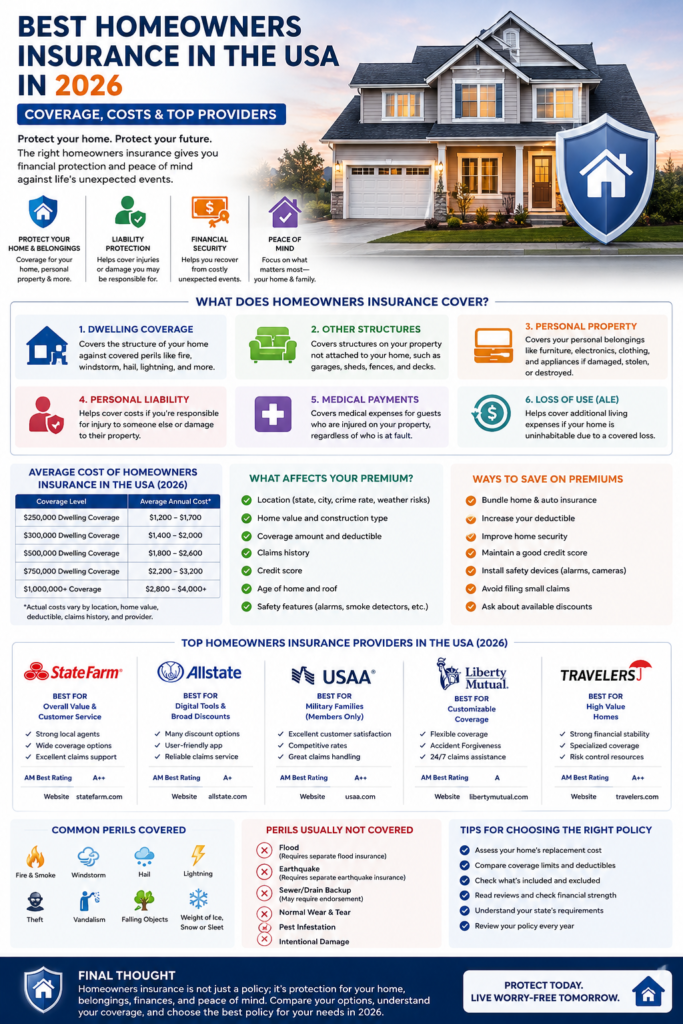
The image explains the main parts of homeowners insurance, what affects its cost, common exclusions, ways to save money, and several major insurance providers. One important point: there is no single best insurer for everyone. The best policy depends on your home’s location, rebuilding cost, coverage needs, deductible, claims history, and available insurers.
🏠 What is homeowners insurance?
Homeowners insurance helps protect your home, belongings, and finances against certain covered losses. A typical policy includes protection for the home’s structure, personal belongings, liability, and additional living expenses. Mortgage lenders commonly require homeowners insurance, but exact requirements vary. (NAIC Content)
1. Dwelling Coverage 🏡
Dwelling Coverage protects the physical structure of your home.
It can help pay to repair or rebuild your house after a covered loss, including parts such as attached structures, permanent fixtures, and built-in appliances.
It may cover:
- Roof
- Walls
- Floors
- Attached garage
- Built-in cabinets
- Permanent fixtures
- Certain built-in appliances
The amount should generally be based on the estimated cost to rebuild the home, not simply its current market value. (Travelers)
Example: A covered fire severely damages your house. Dwelling coverage may help pay for covered repairs or rebuilding, subject to your policy limits and deductible.
2. Other Structures Coverage 🏗️
This covers eligible structures on your property that are not attached to your main home.
Examples include:
- Detached garage
- Shed
- Fence
- Gazebo
- Guesthouse
The exact coverage and limits depend on the policy. (Travelers)
3. Personal Property Coverage 📦
This protects your personal belongings against covered losses.
Examples include:
- Furniture
- Clothing
- Electronics
- Appliances
- Other household belongings
However, valuable items such as jewelry, collectibles, cash, silverware, or fine art may have special limits. You may need additional coverage or a special endorsement for higher-value items. (Travelers)
Example: If a covered fire destroys your furniture and electronics, personal property coverage may help replace eligible items according to the policy terms.
4. Personal Liability Coverage ⚖️
Liability coverage helps protect you if you or another covered household member is legally responsible for causing:
- Bodily injury to another person
- Damage to another person’s property
- Certain legal expenses and defense costs
Example: A visitor is injured at your home and you are found legally responsible. Liability coverage may help with covered damages and legal expenses. (Travelers)
5. Medical Payments to Others ➕
This coverage can help pay for certain medical expenses when a guest is injured, subject to the policy terms and limits.
It is generally different from personal liability coverage because medical payments coverage may apply in some situations without first establishing full legal liability. The available amount is usually limited. (State Farm)
6. Loss of Use / Additional Living Expenses (ALE) 🏨
If a covered loss makes your home temporarily uninhabitable, this coverage can help with certain additional costs of living elsewhere.
Possible expenses may include:
- Temporary hotel or rental housing
- Increased food costs
- Additional utility expenses
- Laundry expenses
- Other eligible extra living costs
Coverage is subject to policy limits and conditions. (Liberty Mutual)
Example: A covered fire damages your home, and you must live in temporary accommodation during repairs.
💰 How Much Does Homeowners Insurance Cost?
The image includes estimated annual price ranges based on dwelling coverage. These should be treated as illustrative examples, not guaranteed 2026 national prices.
There is no single accurate nationwide price for every home because premiums can vary dramatically by:
- State
- City and ZIP code
- Local weather and catastrophe risk
- Home rebuilding cost
- Age and condition of the home
- Roof age and materials
- Deductible
- Coverage limits
- Claims history
- Available discounts
- Insurer and policy options
The NAIC publishes homeowners market and premium data using the latest available reporting year, and the Insurance Information Institute notes that premiums have been affected by replacement costs and weather-related risks. (NAIC Content)
Important difference: Home value vs. rebuilding cost
If your house could sell for $500,000, that does not automatically mean you need exactly $500,000 in dwelling coverage. Insurance coverage is generally concerned with the estimated cost to repair or rebuild the insured structure. (Travelers)
📈 What Affects Your Premium?
1. Location
Homes in areas with higher exposure to hurricanes, wildfires, hail, windstorms, flooding, or other risks may cost more to insure.
2. Rebuilding cost
Larger homes and homes with more expensive construction materials generally require more coverage.
3. Age and condition of the home
Older electrical systems, plumbing, roofs, or other building components may affect insurance availability and pricing.
4. Deductible
A deductible is the amount you generally pay out of pocket on a covered loss before the insurer pays its portion.
Usually:
- Higher deductible → potentially lower premium
- Lower deductible → potentially higher premium
But you should choose an amount you can realistically afford after a loss. (NAIC Content)
5. Claims history
Previous claims can affect underwriting and pricing.
6. Coverage limits and options
More protection or additional endorsements can increase the premium.
7. Safety and risk features
Alarm systems, smoke detectors, newer roofs, and other features may affect pricing or discounts, depending on the insurer and location.
🔥 Common Perils That May Be Covered
Depending on your specific policy, homeowners insurance may protect against certain events such as:
- Fire and smoke
- Windstorms
- Hail
- Lightning
- Theft
- Vandalism
- Certain types of sudden accidental damage
Never assume every policy covers every event. The covered causes of loss depend on your policy form, endorsements, exclusions, and limits. (State Farm)
❌ What Is Commonly Not Covered?
The image correctly highlights several risks that often require separate coverage or are commonly excluded.
🌊 Flood
Standard homeowners policies generally do not cover flood damage. Separate flood insurance may be needed. (NAIC Content)
🌎 Earthquake
Earthquake damage is generally excluded from standard homeowners policies, although separate coverage or endorsements may be available. (NAIC Content)
🐜 Wear and tear or maintenance problems
Normal deterioration, poor maintenance, and many pest-related problems are generally not what standard homeowners insurance is designed to cover. (Allstate)
💧 Water damage
Coverage depends heavily on what caused the water damage. For example, some sudden and accidental water damage may be treated differently from flooding or sewer backup. Always check the policy and consider available endorsements where appropriate. (Liberty Mutual)
💵 Ways to Save on Homeowners Insurance
The image suggests several ways to potentially reduce costs:
1. Bundle policies
Combining home and auto insurance may qualify you for a discount, depending on the insurer.
2. Increase your deductible
This may lower your premium, but increases your potential out-of-pocket cost when making a covered claim.
3. Improve home safety
Depending on the insurer, protective devices and home improvements may affect discounts or pricing.
4. Maintain good insurance and financial eligibility factors
Available discounts and underwriting factors vary by state and insurer.
5. Review coverage regularly
If you renovate your home, buy expensive belongings, or experience major changes, your existing limits may no longer be appropriate.
6. Compare quotes
Compare more than just price. Look at:
- Coverage limits
- Deductibles
- Exclusions
- Endorsements
- Claim service
- Financial strength
- Available discounts
🏆 Major Homeowners Insurance Providers Shown
These companies are examples of major providers, not a universal ranking from #1 to #5. Availability, pricing, and policy options vary by state and customer.
- State Farm — A major U.S. insurer offering dwelling, personal property, liability, additional living expense, and other coverage options. (State Farm)
- Allstate — Offers homeowners coverage with standard categories such as dwelling, other structures, personal property, and liability. (Allstate)
- USAA — Primarily serves eligible members of the military community and their families, subject to eligibility rules.
- Liberty Mutual — Offers customizable homeowners coverage, including home, personal property, liability, and additional living expense protection. (Liberty Mutual)
- Travelers — Offers dwelling, other structures, personal property, liability, and loss-of-use coverage options. (Travelers)
The latest available 2024 market-share data published by the Insurance Information Institute/NAIC data lists State Farm, Allstate, USAA, Liberty Mutual, Farmers, American Family, Travelers, Chubb, Nationwide, and Auto-Owners among the largest homeowners insurance writers by direct premiums. That does not mean each is available or best for every homeowner. (Triple-I)
✅ How to Choose the Right Policy
Before purchasing homeowners insurance, follow these steps:
1. Calculate your rebuilding cost
Focus on what it would cost to rebuild the home, not only its market price.
2. Create a home inventory
Make a list, video, or photos of your belongings.
3. Check the coverage limits
Make sure your dwelling, personal property, liability, and loss-of-use limits fit your situation.
4. Understand your deductible
Choose an amount you could afford to pay after a covered loss.
5. Check exclusions carefully
Especially for flood, earthquake, water backup, high-value property, and location-specific risks.
6. Ask about endorsements
Additional protection may be available for items such as jewelry, valuable collections, water backup, or other specific risks.
7. Compare multiple quotes
The cheapest policy is not always the best policy.
8. Review the policy every year
Update it after renovations, major purchases, or significant changes in rebuilding costs.
Final Conclusion
Homeowners insurance is more than protection for the building itself. A good policy can combine protection for your home, belongings, personal liability, guest injuries, and additional living expenses after a covered loss.
For 2026, the most important approach is to compare coverage—not just premiums. Check exactly what is covered, what is excluded, how much the insurer will pay, and how much you would need to pay through your deductible.
Best policy = the coverage that properly matches your home’s risks and rebuilding needs at a price you can afford.
This is general educational information, not insurance or legal advice. Actual coverage, pricing, eligibility, exclusions, and requirements vary by insurer, policy, and U.S. state.