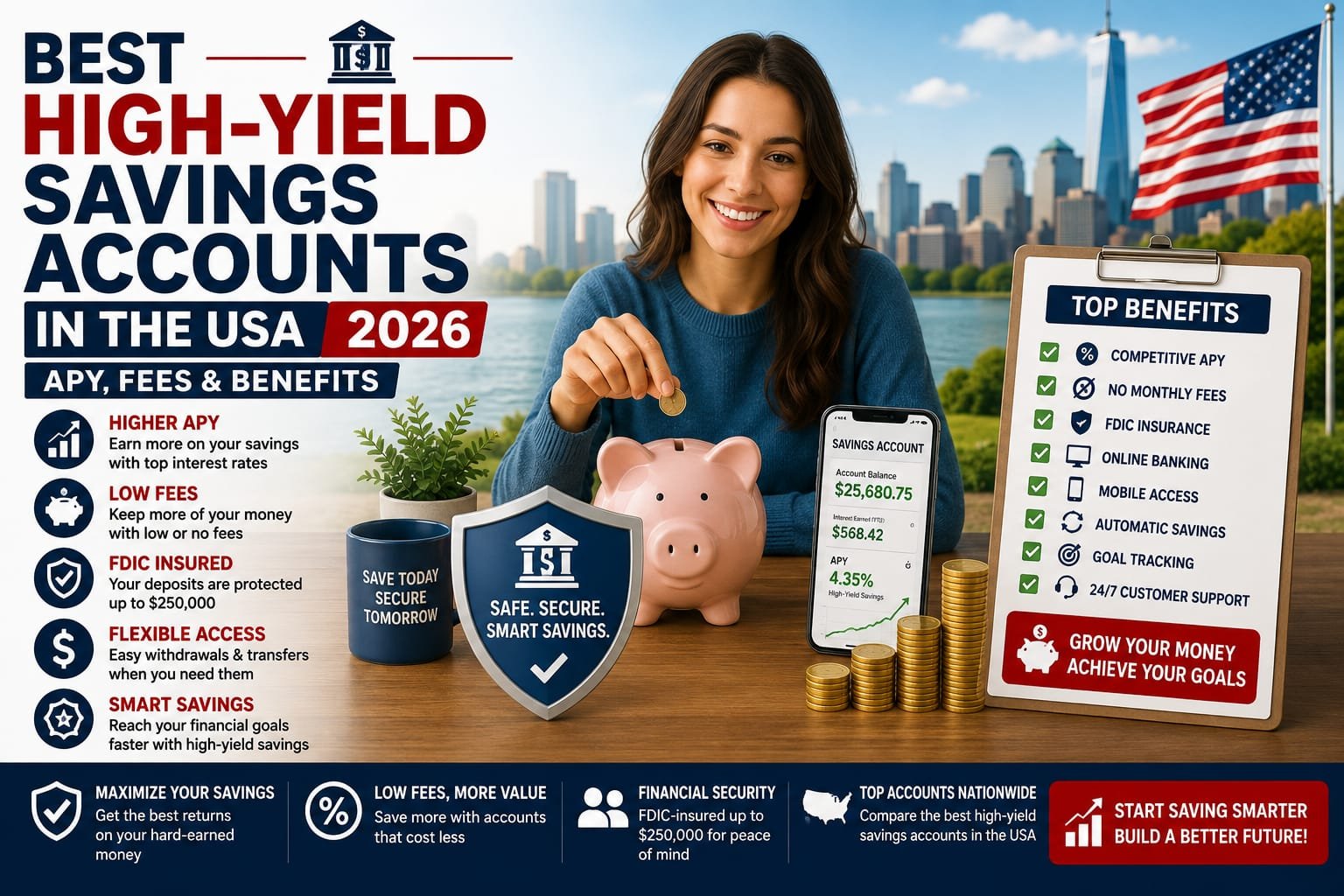
Best High-Yield Savings Accounts in the USA in 2026: APY, Fees & Benefits
A high-yield savings account (HYSA) is a savings account that pays substantially more interest than a typical traditional savings account while generally keeping your money accessible.
As of August 18, 2026, the FDIC national average savings rate is about 0.38%, while some of the best high-yield accounts are offering around 4%–5% APY.
That difference can be significant for an emergency fund, down payment, business reserve or other cash savings.
🏆 Best High-Yield Savings Accounts in 2026
Current market comparisons identify several competitive options:
Account Approx. APY* Minimum Best for
Accordia Bank Up to 5.00% $100 Highest advertised yield
Forbright Bank 4.15% $0 Strong rate + no minimum
CIT Bank 4.10% $100 Higher-balance savers
Happen Bank 4.00% $0 No-minimum option
First National Bank of America 4.00% $1,000 Competitive yield
Vio Bank 3.99% $100 Online savings
Bread Savings 3.95% $100 Simple savings
EverBank 3.90% $0 No minimum
Popular Direct 3.90% $100 Competitive online rate
*APYs can change and may have balance tiers, eligibility requirements or promotional conditions. Bankrate’s August 2026 comparison lists these rates and minimums.
Important
The highest APY isn’t automatically the best account. Check whether the advertised rate applies to your entire balance, whether it is promotional, and whether there are minimum-balance or transaction requirements.
⸻
- Accordia Bank — Best for Highest Advertised APY
Accordia Bank is currently among the highest-rate options in national comparisons, with an advertised 5.00% APY and a $100 minimum deposit.
Potential benefits
- Very high APY
- Relatively small minimum deposit
- Attractive for maximizing interest
Watch out for
A high advertised APY can come with conditions or balance limitations. Always verify the current terms before depositing a large amount.
Best for: Savers primarily focused on maximizing APY.
⸻
- Forbright Bank — Best Combination of Rate and Accessibility
Forbright is currently listed around 4.15% APY with no minimum deposit in Bankrate’s August 2026 comparison.
Potential benefits
- Competitive APY
- No minimum deposit
- Online savings structure
- Suitable for smaller and larger balances
Kiplinger also lists Forbright among competitive high-yield savings options.
Best for: People who want a strong rate without needing a large opening deposit.
⸻
- CIT Bank — Best for Higher Balances
CIT Bank is currently listed around 4.10% APY with a $100 minimum deposit in Bankrate’s comparison.
Potential benefits
- Competitive yield
- Low minimum
- Online banking
- Good option for larger savings balances
Best for: Savers who want a competitive rate without a large opening requirement.
⸻
- Happen Bank — Best No-Minimum Option
Happen Bank is listed at approximately 4.00% APY with no minimum deposit.
This can be useful if you’re just starting to build an emergency fund and don’t have thousands of dollars available.
Best for: New savers and smaller balances.
⸻
- Bread Savings — Best Simple Online Option
Bread Savings is currently around 3.95% APY, with a $100 minimum in Bankrate’s August 2026 comparison.
Money’s August 2026 savings-account roundup also includes Bread among its recommended options.
Best for: Savers looking for a straightforward online savings account.
⸻
- EverBank — Good No-Minimum Alternative
EverBank is currently listed around 3.90% APY with no minimum deposit in Bankrate’s comparison.
Best for: People who want a competitive rate without maintaining a large minimum balance.
⸻
- Popular Direct — Competitive Online Savings
Popular Direct is listed around 3.90% APY with a $100 minimum deposit.
Best for: Savers comparing online banks primarily on yield and deposit requirements.
⸻
What Is APY?
APY = Annual Percentage Yield.
It represents how much you can earn over a year while accounting for compounding.
For example:
If you deposit:
$10,000
at:
4.00% APY
you could earn approximately:
$400 in interest over one year
assuming the APY remained unchanged and the money stayed in the account.
At 0.38%, roughly the FDIC national average cited for August 2026, the same $10,000 would generate only about $38 over a year.
That’s a difference of approximately:
$362 per year.
⸻
How Much Can You Earn?
Approximate first-year interest at different APYs:
Balance 0.38% 3.00% 4.00% 5.00%
$1,000 $3.80 $30 $40 $50
$5,000 $19 $150 $200 $250
$10,000 $38 $300 $400 $500
$25,000 $95 $750 $1,000 $1,250
$50,000 $190 $1,500 $2,000 $2,500
$100,000 $380 $3,000 $4,000 $5,000
These are simplified illustrations; actual interest depends on daily balances, compounding and whether the APY changes.
⸻
What Are the Fees?
One of the biggest advantages of many HYSAs is that they can have $0 monthly maintenance fees.
But don’t assume every fee is zero.
Check for:
- Monthly maintenance fee
- Excess withdrawal fee
- Wire-transfer fee
- Returned-payment fee
- Paper statement fee
- Minimum-balance requirements
- Out-of-network ATM fees
For example, Discover’s savings account is reported as having no monthly maintenance fee.
⸻
Are High-Yield Savings Accounts Safe?
For a bank account, look for FDIC insurance.
The standard FDIC coverage is generally:
$250,000 per depositor, per insured bank, for each ownership category.
For credit unions, the equivalent federal insurance is generally provided by the NCUA.
This is different from investing in stocks, ETFs or cryptocurrency. A properly insured deposit account protects eligible deposits within applicable limits, although it does not guarantee a particular APY.
Kiplinger notes that many HYSAs are FDIC- or NCUA-insured and that eligible deposits are generally protected up to $250,000 per depositor under the applicable insurance system.
⸻
Why Are HYSA Rates Higher Than Traditional Savings?
Online banks often have lower operating costs because they don’t maintain large networks of physical branches.
They can potentially pass some of those savings to customers through higher deposit rates.
In August 2026, the difference is substantial: the FDIC national average is around 0.38%, while top HYSAs can reach approximately 4%–5%.
⸻
Are HYSA Rates Fixed?
No.
This is extremely important.
Most high-yield savings accounts have variable APYs.
The bank can change the rate.
Savings yields are influenced by broader interest-rate conditions and Federal Reserve policy. The Fed has held its benchmark rate steady through the first part of 2026 after cutting rates in 2025, and market expectations can affect savings yields.
So:
4.00% APY today does not mean you’ll receive 4.00% forever.
⸻
HYSA vs. Traditional Savings Account
Feature HYSA Traditional Savings
Interest rate Usually much higher Usually lower
Accessibility High High
Monthly fees Often $0 Varies
Branches Often limited/none More common
FDIC insurance Usually available Usually available
Rate Variable Variable
Best for Maximizing cash interest Convenience/branch banking
⸻
HYSA vs. Certificate of Deposit
A CD generally locks your money for a specific period in exchange for a fixed interest rate.
HYSA
- Variable APY
- Easy access
- Good for emergency funds
- No fixed maturity date
CD
- Usually fixed APY
- Money is committed for a term
- Early withdrawal may result in a penalty
- Can be useful when you know you won’t need the money
As of August 18, 2026, some of the best CD rates are around 4.14%–4.55%, so comparing CDs with HYSAs can make sense if you don’t need immediate access to your money.
⸻
Best HYSA for Different Goals
🥇 Highest APY
Accordia Bank
Currently advertised around 5.00% APY, subject to its terms and eligibility.
💰 No Minimum Deposit
Forbright / Happen / EverBank
These are among the options listed with no minimum opening deposit.
🏦 Well-known Online Banking Options
Ally, Marcus, Capital One, SoFi
These may not always have the absolute highest APY, but they can offer useful digital banking features and broader ecosystems. Money’s August 2026 roundup includes Ally, Capital One, Marcus and SoFi among its recommended savings options.
💵 Emergency Fund
Prioritize:
No monthly fee + FDIC/NCUA insurance + easy transfers + competitive APY
rather than simply choosing the highest advertised rate.
⸻
How to Choose the Best HYSA
Before opening an account, compare these 8 factors:
- APY
Higher is generally better, assuming all other terms are comparable.
- Minimum deposit
Some accounts require $0, while others require $100, $1,000 or more.
- Minimum balance
Check whether you must maintain a certain balance to receive the advertised APY.
- Fees
Look specifically for monthly and transaction-related fees.
- Insurance
Confirm that the institution is FDIC-insured or NCUA-insured, as applicable.
- Access
Check how quickly you can transfer money to your checking account.
- Mobile app
If it’s an online bank, app quality can matter.
- Rate conditions
Check whether the APY is:
- Promotional
- Balance-tiered
- Conditional
- Limited to a specific amount
⸻
Common HYSA Mistakes
❌ Choosing the highest APY without reading the conditions
A 5% APY may apply only to a limited balance.
❌ Ignoring fees
A high rate isn’t useful if fees consume the interest.
❌ Keeping more than insured limits at one bank
If you have substantially more than $250,000, understand the applicable FDIC ownership categories and consider how deposits are structured.
❌ Assuming the rate is permanent
Savings APYs can change.
❌ Using an HYSA for long-term growth instead of investing
A savings account is designed primarily for cash preservation and liquidity. It isn’t the same as a diversified investment portfolio.
⸻
How Much Should You Keep in a HYSA?
A common approach is to keep your emergency fund in a highly liquid savings account.
For example, if your essential expenses are:
$3,000/month
and you want six months of emergency savings:
$3,000 × 6 = $18,000
An HYSA could be an appropriate place to keep that cash because it can earn interest while remaining relatively accessible.
The exact emergency-fund size should depend on your income stability, expenses and circumstances.
⸻
2026 HYSA Strategy
A simple strategy is:
Step 1: Keep your everyday spending money in checking.
Step 2: Move your emergency fund into a competitive HYSA.
Step 3: Compare APYs every few months.
Step 4: Watch for promotional rates expiring.
Step 5: Keep deposits within applicable FDIC/NCUA insurance limits.
Step 6: Consider CDs for money you definitely won’t need during the CD term.
⸻
Final Verdict
For August 2026, the U.S. high-yield savings market remains attractive. The top advertised rates are reaching approximately 4%–5% APY, compared with roughly 0.38% for the FDIC national average savings rate.
Best choices by priority
🏆 Highest advertised yield: Accordia Bank
💰 Strong rate with no minimum: Forbright Bank
💵 Competitive higher-balance option: CIT Bank
🧾 No-minimum alternative: Happen Bank
📱 Well-known online banking ecosystems: Ally, Marcus, Capital One, SoFi
🔒 Emergency fund: Choose an FDIC/NCUA-insured account with no unnecessary fees and easy transfers.
The most important thing is not just the headline APY. Compare the rate, balance requirements, fees, insurance, withdrawal/access rules and whether the rate is promotional.
Rates change frequently. Verify the institution’s current APY and account terms before opening an account. This is general financial education, not individualized financial advice.