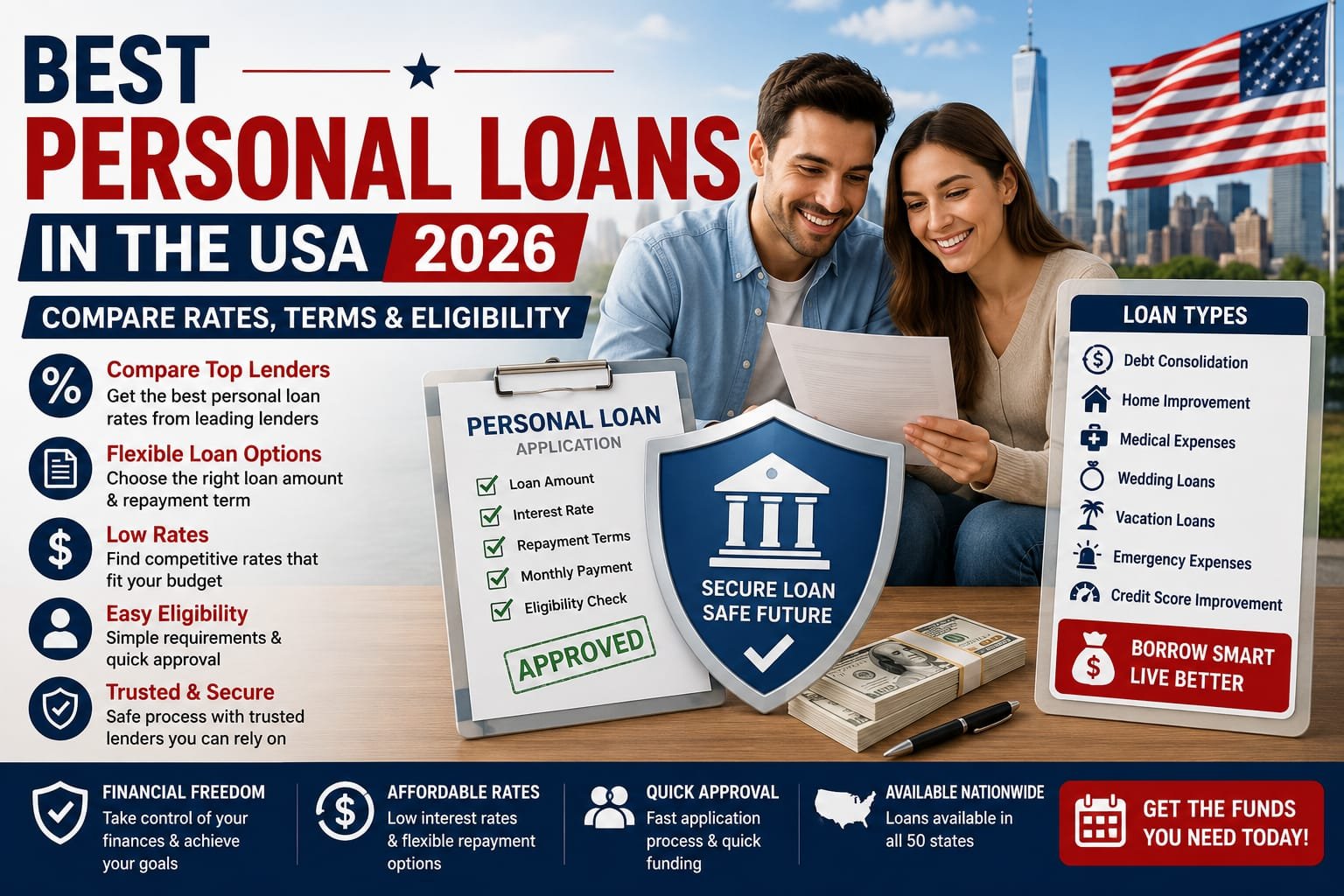
Best Personal Loans in the USA in 2026: Rates, Terms & Eligibility
If you’re planning an article, blog post, or website page on “Best Personal Loans in the USA in 2026,” here is a complete, up-to-date overview you can use.
Important: Personal-loan rates change frequently, and the rate you actually receive depends on your credit profile, income, loan amount, term and lender. The figures below are current-market ranges, not guaranteed offers.
- What Is a Personal Loan?
A personal loan is money borrowed from a bank, credit union, or online lender that you repay through scheduled installments, usually with a fixed interest rate.
Personal loans are commonly used for:
- Debt consolidation
- Home improvement
- Medical expenses
- Emergency expenses
- Major purchases
- Weddings and events
- Moving expenses
- Auto-related expenses
- Other approved personal purposes
Most personal loans are unsecured, meaning you don’t have to pledge your house or car as collateral.
⸻
- Personal Loan Rates in the USA in 2026
As of 2026, personal-loan APRs can vary considerably. Bankrate reports typical rates around 8%–36%, with the lowest rates generally available to borrowers with excellent credit.
Experian reported an average personal-loan APR of approximately 13.72% for a 36-month loan and 14.92% for a 60-month loan in its July 2026 data.
Your rate may be affected by:
- Credit score
- Credit history
- Income
- Debt-to-income ratio
- Loan amount
- Repayment term
- Employment history
- Lender
- State of residence
Approximate rate by credit profile
Credit profile Possible APR range
Excellent ~6%–15%
Good ~10%–20%
Fair ~18%–30%
Poor ~25%–36%
These are broad market ranges, not guaranteed offers. NerdWallet’s July 2026 prequalification data, for example, showed average online-lender rates ranging from about 14.48% for excellent credit to 26.41% for bad credit.
⸻
- Best Personal Loan Providers to Compare in 2026
There isn’t one lender that’s best for everyone. The right choice depends on your credit score, loan amount and purpose.
- SoFi — Best Overall for Many Borrowers
SoFi is frequently included among leading personal-loan providers.
Potential advantages:
- Loans up to around $100,000
- No prepayment penalty
- Competitive rates for qualified borrowers
- Online application
- Potential fast funding
Current published market comparisons put SoFi’s APR range around 6.99%–35.49%, although actual offers depend on the borrower.
Best for: Good-to-excellent-credit borrowers looking for larger loans and competitive terms.
⸻
- LightStream — Best for Excellent Credit & Long Terms
LightStream can be attractive to borrowers with strong credit who want larger loans or longer repayment periods.
Some 2026 comparisons list loans up to $100,000, with repayment terms potentially extending as long as 20 years for certain purposes.
Best for:
- Excellent credit
- Large projects
- Longer repayment periods
Important: A longer term can reduce the monthly payment but substantially increase the total interest paid.
⸻
- Upstart — Good for Limited Credit History
Upstart uses additional information beyond traditional credit-score factors in its underwriting process.
It offers loans up to approximately $75,000, with commonly available three- or five-year terms.
Best for:
- Limited credit history
- Borrowers who may not fit traditional underwriting models
⸻
- Upgrade — Good for Fair Credit
Upgrade is one option worth comparing if your credit isn’t excellent.
It may also offer secured-loan options, where collateral can affect eligibility and pricing. Current comparisons show APRs potentially reaching 35.99% depending on the borrower.
Best for: Fair-credit borrowers looking for flexible options.
⸻
- Universal Credit — Option for Lower Credit Scores
Universal Credit is aimed more toward borrowers with poor-to-fair credit.
Some 2026 comparisons report eligibility for borrowers with credit scores around 580 or higher, subject to other requirements.
Best for: Borrowers who may have difficulty qualifying with traditional lenders.
Warning: Lower-credit borrowers generally pay significantly higher APRs.
⸻
- Navy Federal Credit Union — Credit Union Option
Navy Federal can be worth considering for eligible military members and their families.
Credit unions can sometimes offer competitive rates compared with online lenders. Current comparisons show Navy Federal personal-loan rates reaching considerably lower levels than many high-cost lenders for qualified members.
Best for: Eligible military-community borrowers.
⸻
- Achieve — Good for Rate Discounts
Achieve can be interesting for borrowers who qualify for multiple discounts.
Potential discounts can involve factors such as:
- Direct payment to creditors
- Co-borrower
- Certain retirement assets
Best for: Borrowers who can take advantage of available discounts.
⸻
- How Much Can You Borrow?
Loan amounts vary significantly by lender.
Depending on the lender and your financial profile, personal loans may range from approximately $1,000 to $100,000 or more. Some lenders specialize in small loans, while others offer larger amounts.
For example:
Loan amount Typical use
$1,000–$5,000 Emergency expenses
$5,000–$15,000 Debt consolidation / repairs
$15,000–$30,000 Major purchases
$30,000–$50,000 Large projects
$50,000–$100,000+ Major renovations / large debt consolidation
You should borrow only what you need and can comfortably repay.
⸻
- Personal Loan Eligibility
Lenders typically examine several factors before approving an application.
Credit score
A higher credit score generally improves your chances of:
- Approval
- Lower APR
- Higher loan amount
- Better repayment terms
Some lenders accept applicants below a 600 credit score, but rates can be substantially higher.
Income
Lenders want evidence that you have enough income to make the monthly payments.
They may ask for:
- Pay stubs
- Bank statements
- Tax documents
- Employment information
Debt-to-income ratio
Your DTI ratio compares your monthly debt obligations with your gross monthly income.
For example:
If you earn $5,000 per month and have $2,000 in monthly debt payments:
DTI = $2,000 ÷ $5,000 = 40%
A lower DTI generally makes you a more attractive borrower.
Credit history
Lenders may examine:
- Previous loans
- Credit-card accounts
- Payment history
- Defaults
- Recent applications
- Outstanding balances
⸻
- APR vs. Interest Rate
This is one of the most important things to understand.
Interest rate is the percentage charged on the borrowed money.
APR (Annual Percentage Rate) generally reflects the interest rate plus certain applicable loan fees.
When comparing lenders, APR is usually more useful than the advertised interest rate alone because it gives you a better picture of borrowing costs.
For example:
Lender A: 10% interest + fees
Lender B: 11% interest + no fees
Lender B might potentially be cheaper depending on the loan structure.
Always compare the complete APR and fee structure.
⸻
- Loan Fees to Watch For
A personal loan can include several fees.
Origination fee
Some lenders deduct an origination fee from your loan proceeds.
For example, if you are approved for $20,000 but the lender charges a 5% origination fee, you may receive less than $20,000.
Late-payment fee
Missing a payment can result in additional charges and potentially damage your credit.
Prepayment penalty
Some loans may charge a fee for paying the loan off early, although many major personal-loan providers don’t.
Other fees
Always read the lender’s loan agreement for:
- Documentation fees
- Returned-payment fees
- Administrative fees
- State-specific charges
⸻
- Short-Term vs. Long-Term Personal Loans
Short-term loan
Example:
$20,000 for 3 years at 12% APR
You’ll generally have a higher monthly payment but pay less total interest.
Long-term loan
Example:
$20,000 for 7 years at 12% APR
Your monthly payment is lower, but you generally pay more interest over the life of the loan.
So:
Short term = higher monthly payment + lower total interest
Long term = lower monthly payment + higher total interest
Long-term loans can extend much further with some lenders, but the extra interest can become substantial.
⸻
- Example: $20,000 Personal Loan
Suppose you borrow:
Loan: $20,000
APR: 12%
Term: 5 years
Your monthly payment would be approximately $445.
Over 60 months, you’d repay approximately $26,700, meaning roughly $6,700 in interest.
The actual payment and total cost will vary according to the lender’s exact APR, fees and repayment structure.
⸻
- Secured vs. Unsecured Personal Loans
Unsecured loan
No collateral is required.
Advantages:
- No asset pledged
- Simple application
- Usually faster
Disadvantages:
- May have higher rates
- Strong credit can be important
Secured loan
You provide an asset as collateral.
Examples could include a vehicle or other qualifying property.
Advantages:
- Potentially easier approval
- Potentially lower interest rate
Disadvantages:
- Your collateral may be at risk if you default
⸻
- How to Apply for a Personal Loan
Step 1 — Check your credit
Review your credit reports and score.
Step 2 — Determine how much you need
Don’t automatically choose the maximum amount offered.
Step 3 — Compare lenders
Compare at least several lenders based on:
- APR
- Loan amount
- Term
- Origination fee
- Monthly payment
- Funding speed
- Prepayment penalties
Step 4 — Prequalify when available
Some lenders allow you to check potential offers using a soft credit inquiry, which generally doesn’t have the same effect as a hard inquiry.
Step 5 — Submit an application
You’ll generally provide:
- Name
- Address
- Income
- Employment
- Requested amount
- Loan purpose
- Identification information
Step 6 — Review the final offer
Don’t focus only on the monthly payment.
Check:
APR + fees + total repayment + loan term.
Step 7 — Receive the money
Depending on the lender and circumstances, funding can occur the same day or within several business days.
⸻
- Personal Loans for Bad Credit
Borrowers with poor credit may still have options, but they should be particularly careful.
Current 2026 comparisons show bad-credit personal-loan APRs can reach roughly 28%–35.99%.
Before accepting an expensive loan, consider:
- Credit-union options
- Adding a qualified co-borrower
- Secured loans
- Borrowing a smaller amount
- Improving your credit before applying
- Negotiating existing debts
- A 0% introductory APR credit card where appropriate
Avoid lenders that guarantee approval regardless of your financial situation.
⸻
- Personal Loan vs. Credit Card
Feature Personal Loan Credit Card
Interest Usually fixed Often variable
Payment Fixed schedule Flexible minimum payment
Funding Lump sum Revolving credit
Best use Large one-time expense Ongoing purchases
Term Fixed Open-ended
Risk Missed payments hurt credit High balances can accumulate
A personal loan can be useful when you know exactly how much you need and want a predictable repayment schedule.
⸻
- Personal Loan vs. Debt Consolidation
A debt-consolidation loan combines multiple debts into one new loan.
For example:
Credit Card A: $5,000
Credit Card B: $4,000
Credit Card C: $3,000
Total debt:
$12,000
You could potentially replace these balances with one $12,000 personal loan.
The main potential advantages are:
- One monthly payment
- Fixed repayment schedule
- Potentially lower APR
- Easier budgeting
But consolidation only helps if the new loan’s total cost is favorable and you avoid rebuilding the credit-card debt afterward.
⸻
- Pros and Cons
Pros
- Fixed monthly payments
- Predictable repayment
- Potentially lower rates than high-interest credit cards
- No collateral for many loans
- Can consolidate multiple debts
- Online applications are convenient
- Funds can often be used for multiple purposes
Cons
- Interest increases the total cost
- Origination fees may apply
- High APRs for poor credit
- Missed payments can damage credit
- Longer terms can mean significantly more interest
- Some borrowers may take on more debt than they can afford
⸻
- How to Get the Lowest Personal Loan Rate
To improve your chances of receiving a competitive APR:
- Maintain a strong credit score.
- Pay existing debts on time.
- Reduce credit-card utilization.
- Improve your debt-to-income ratio.
- Compare several lenders.
- Consider a shorter repayment period if affordable.
- Look for lenders without origination fees.
- Check available autopay discounts.
- Consider a qualified co-borrower if appropriate.
- Prequalify with multiple lenders where possible.
The difference between a high and low APR can mean thousands of dollars over the life of a larger loan.
⸻
- Best Personal Loan by Borrower Type
Borrower Potential option
Excellent credit LightStream
Good credit SoFi
Large loan SoFi / LightStream
Long repayment LightStream
Limited credit history Upstart
Fair credit Upgrade
Poor credit Universal Credit
Military eligibility Navy Federal
Looking for discounts Achieve
These are categories rather than guarantees; the best lender depends on the actual offers you qualify for. Current 2026 comparisons support these general positioning choices.
⸻
- What to Check Before Signing
Before accepting a personal loan, check these 10 items:
- APR
- Interest rate
- Loan amount
- Monthly payment
- Loan term
- Origination fee
- Late fee
- Prepayment penalty
- Total repayment amount
- Funding time
Don’t choose a loan simply because it advertises the lowest starting APR. The advertised minimum may only be available to borrowers with exceptional credit and specific financial profiles.
⸻
- Bottom Line
The best personal loan in the USA in 2026 isn’t necessarily the lender with the lowest advertised rate.
For a strong-credit borrower, lenders such as SoFi and LightStream may be attractive. Borrowers with limited or weaker credit may find options from Upstart, Upgrade or Universal Credit more accessible, while eligible military borrowers may want to compare Navy Federal.
The smartest approach is to prequalify where possible, compare multiple offers, examine the APR and fees, and choose the shortest affordable repayment period.
And remember: a personal loan is still debt. Borrow only what you can comfortably repay.
2026 market snapshot: personal-loan APRs broadly range from around 6% to 36%, with the lowest rates generally reserved for highly qualified borrowers.