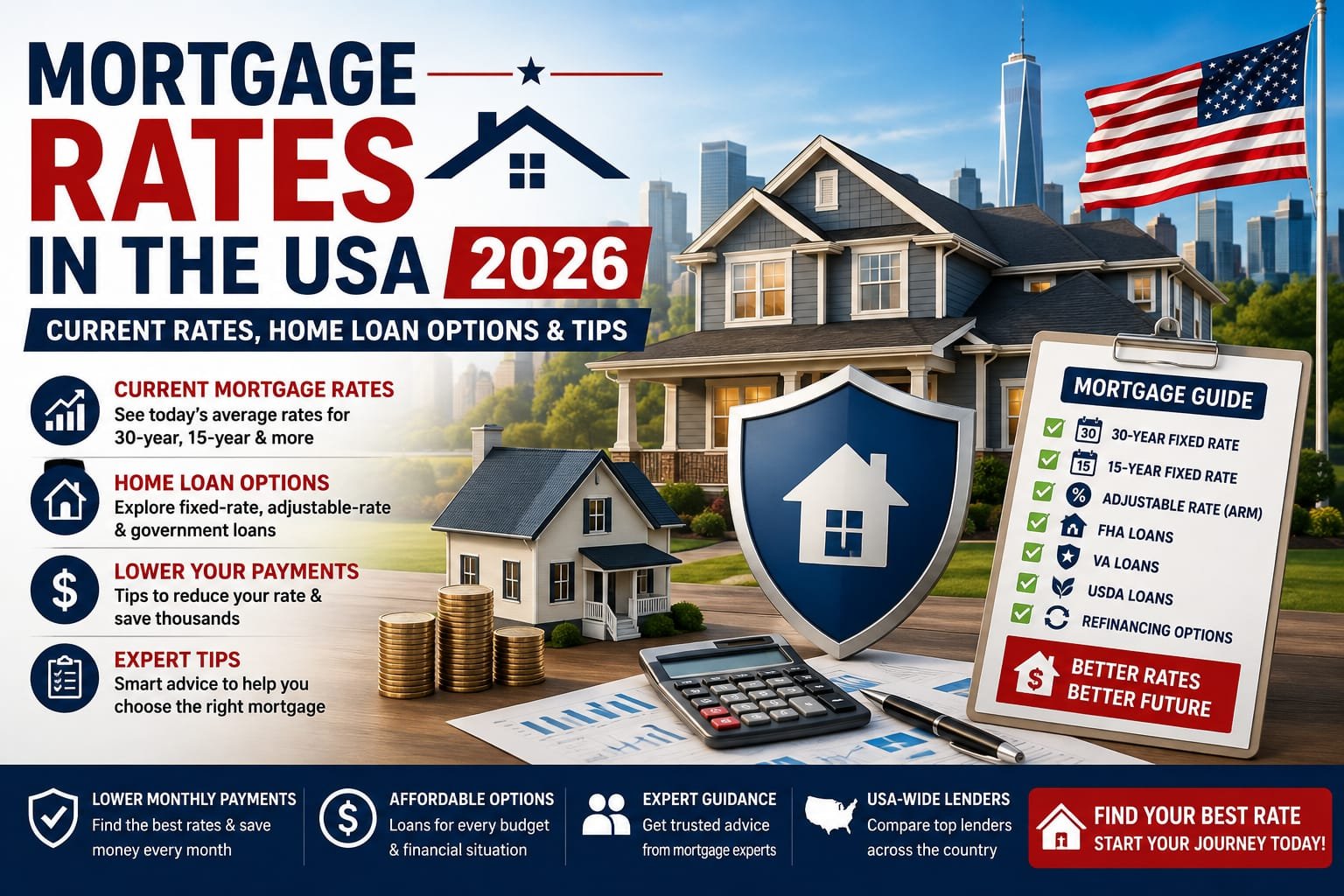
Mortgage Rates in the USA in 2026: Current Rates, Home Loan Options & Tips
If you’re creating a finance article for 2026, this is a strong topic because mortgage rates remain one of the biggest factors affecting U.S. home affordability.
🏠 Current Mortgage Rates in the USA — August 2026
As of August 18, 2026, U.S. mortgage rates are still in the mid-6% range.
Freddie Mac’s latest weekly survey, dated August 13, 2026, showed:
Mortgage type Average rate
30-year fixed 6.67%
15-year fixed 5.96%
Daily lender-market data can differ. For example, a national average published for August 18 showed a 30-year fixed rate around 6.71% and a 15-year rate around 6.08%.
Important: These are market averages. Your actual mortgage rate can be higher or lower depending on credit score, down payment, loan type, property, location, loan amount, debt-to-income ratio and lender.
⸻
- What Is a Mortgage?
A mortgage is a loan used to purchase a home or other real estate.
You typically make monthly payments consisting of:
- Principal
- Interest
- Property taxes
- Homeowners insurance
- Mortgage insurance, if applicable
- HOA fees, where applicable
The home generally serves as collateral for the mortgage.
⸻
- Why Are Mortgage Rates Important?
Even a small difference in mortgage rates can significantly affect the total cost of a home.
For example, consider a $400,000 mortgage:
At 6%
Approximate principal + interest payment:
$2,398/month
At 7%
Approximate principal + interest payment:
$2,661/month
That’s approximately $263 more every month before taxes and insurance.
Over 30 years, the difference can amount to a very large additional interest cost.
⸻
- What Is Driving Mortgage Rates in 2026?
Mortgage rates don’t simply move in lockstep with the Federal Reserve’s policy rate.
Long-term Treasury yields and expectations about inflation and economic growth are major influences.
Recent 2026 market conditions have included:
- Persistent inflation concerns
- Higher Treasury yields
- Energy-price uncertainty
- Geopolitical risk
- Expectations about future Federal Reserve policy
On August 18, the U.S. 10-year Treasury yield was around 4.74%, while the 30-year Treasury yield reached its highest level since 2007, according to Reuters.
This helps explain why mortgage rates can remain elevated even when the Federal Reserve isn’t actively raising its benchmark rate.
⸻
- Best Mortgage Options in 2026
There isn’t one mortgage that’s best for every homebuyer.
The major options include:
Conventional Mortgage
Conventional loans are not directly insured by the federal government and are commonly associated with Fannie Mae and Freddie Mac.
Potential advantages:
- Competitive rates for qualified borrowers
- Flexible loan options
- Can be suitable for first-time and repeat buyers
- Potentially lower mortgage insurance costs than FHA depending on the borrower
The CFPB notes that conventional loans typically cost less than FHA loans but can be harder to qualify for.
Best for: Borrowers with good credit and sufficient income/down payment.
⸻
- FHA Loans
FHA loans are insured by the Federal Housing Administration.
They can be attractive for borrowers who have:
- Smaller down payments
- Lower credit scores
- Limited savings
The CFPB specifically identifies FHA loans as an option for borrowers making a small down payment.
Potential downside: Mortgage insurance can increase the overall cost.
Best for: First-time buyers and borrowers who don’t qualify for the most competitive conventional financing.
⸻
- VA Loans
VA loans are designed for eligible:
- Veterans
- Active-duty servicemembers
- Certain surviving spouses
They can offer significant advantages, potentially including no down payment for qualifying borrowers.
The CFPB identifies VA loans as an option for eligible servicemembers and veterans.
Best for: Eligible military borrowers.
⸻
- USDA Loans
USDA-backed mortgages are designed to help eligible borrowers purchase homes in qualifying rural areas.
They can be particularly useful for borrowers who meet the program’s income and property requirements.
Best for:
- Eligible rural-area buyers
- Low- to moderate-income households
The CFPB lists USDA loans among programs designed for borrowers purchasing in rural areas.
⸻
- Jumbo Mortgages
A jumbo mortgage is generally used when the loan amount exceeds the conforming loan limits applicable to the property and location.
These loans are commonly used for expensive properties.
Because the loan is larger, lenders may require:
- Strong credit
- Higher income
- Larger reserves
- Lower debt-to-income ratio
- Larger down payment
Best for: Buyers purchasing high-value properties that require financing above conventional conforming limits.
⸻
- 30-Year Fixed Mortgage
The 30-year fixed mortgage is one of the most popular U.S. mortgage structures.
Your interest rate remains fixed for the life of the loan.
Advantages
- Lower monthly payment
- Predictable payments
- Easier budgeting
- Long repayment period
Disadvantages
- More total interest
- Slower equity accumulation initially
Freddie Mac’s August 13, 2026 survey put the average 30-year fixed rate at 6.67%.
⸻
- 15-Year Fixed Mortgage
A 15-year mortgage has a shorter repayment period.
Advantages
- Lower total interest
- Faster equity buildup
- Usually lower interest rate than a 30-year mortgage
Disadvantages
- Higher monthly payment
- Less monthly cash-flow flexibility
Freddie Mac’s August 13 survey showed an average 15-year fixed rate of 5.96%.
⸻
- Adjustable-Rate Mortgage — ARM
An ARM typically starts with a fixed interest rate for a certain period before the rate can adjust.
Examples include:
- 5/1 ARM
- 5/6 ARM
- 7/1 ARM
- 10/1 ARM
For example, a 5/1 ARM generally means the initial rate is fixed for five years and then can adjust periodically.
Advantages
- Potentially lower initial rate
- Lower initial payment
- Can make sense for some short-term homeowners
Risks
After the introductory period, the interest rate can rise, potentially increasing the monthly payment significantly.
The CFPB warns that ARM payments can increase substantially after the initial fixed period.
⸻
- Fixed vs. ARM
Feature Fixed Mortgage ARM
Initial rate Usually higher Often lower
Rate changes No Yes
Payment predictability High Lower
Long-term risk Lower Higher
Good for Long-term ownership Shorter/uncertain ownership
Rate protection Strong Limited
For many homeowners who value payment certainty, a fixed-rate mortgage can be easier to manage.
⸻
- How Much Down Payment Do You Need?
The required down payment depends on the loan program.
Possible structures include:
- 0% for some eligible VA/USDA borrowers
- Low down payment FHA options
- Conventional loans with low-down-payment programs
- 20% or more to potentially avoid conventional PMI
A larger down payment can potentially:
- Reduce the loan amount
- Reduce monthly payments
- Lower interest paid
- Improve your loan-to-value ratio
But don’t automatically put every dollar of savings into the house. Maintaining an emergency fund is also important.
⸻
- Mortgage Insurance
Mortgage insurance protects the lender rather than the homeowner.
Depending on the loan type, it can include:
PMI
Private mortgage insurance is generally associated with conventional mortgages when the borrower’s down payment is below certain thresholds.
FHA mortgage insurance
FHA loans have their own mortgage-insurance requirements.
VA funding fee
Eligible VA borrowers may have a VA funding fee, although exemptions can apply.
Mortgage insurance can significantly change the actual monthly cost of a mortgage, so don’t compare loans using interest rate alone.
⸻
- What Determines Your Mortgage Rate?
Your individual rate may depend on:
Credit score
Higher credit scores generally help borrowers qualify for better rates.
Down payment
A larger down payment can reduce lender risk.
Debt-to-income ratio
Lenders evaluate how much of your income is already committed to debt payments.
Loan term
15-year and 30-year loans typically have different rates.
Loan type
Conventional, FHA, VA, USDA and jumbo loans have different pricing.
Property type
Rates can vary depending on whether you’re purchasing:
- Primary residence
- Second home
- Investment property
Loan amount
The size of the loan can affect pricing and eligibility.
⸻
- How to Get the Best Mortgage Rate in 2026
- Improve your credit
Before applying:
- Pay bills on time
- Reduce credit-card balances
- Avoid unnecessary new credit
- Check your credit reports for errors
- Save for a larger down payment
A larger down payment can reduce the amount you need to borrow.
- Compare multiple lenders
Don’t accept the first mortgage quote.
The CFPB recommends getting multiple loan offers and comparing them.
- Compare APR, not just interest rate
A mortgage with a lower advertised rate isn’t necessarily cheaper if it comes with substantial points or fees.
- Ask about rate locks
A rate lock can protect you from certain rate increases during a specified period.
Freddie Mac explains that rate locks can help borrowers protect their mortgage rate while completing the transaction.
⸻
- What Are Mortgage Points?
Mortgage points are upfront fees paid to the lender in exchange for a lower interest rate.
For example, one point is generally equal to 1% of the loan amount.
On a $400,000 mortgage:
1 point = $4,000
Whether buying points makes sense depends on:
- How much the rate falls
- How long you expect to keep the mortgage
- Your upfront cash
- Your expected savings
Calculate the break-even period before paying points.
⸻
- Mortgage Closing Costs
Buying a home involves more than the down payment.
Closing costs can include:
- Loan origination charges
- Appraisal
- Credit report
- Title services
- Recording fees
- Prepaid taxes
- Homeowners insurance
- Escrow deposits
- Discount points
Always review the Loan Estimate and Closing Disclosure carefully.
⸻
- Example: $400,000 Mortgage at 6.67%
Suppose you borrow:
$400,000
at approximately:
6.67%
for:
30 years
Your estimated principal-and-interest payment would be around $2,573 per month.
Over 30 years, total principal and interest would be approximately $926,000, meaning roughly $526,000 of interest.
This does not include:
- Property taxes
- Homeowners insurance
- HOA fees
- Mortgage insurance
So your actual monthly housing cost could be considerably higher.
⸻
- Should You Buy a Home in 2026?
There’s no universal answer.
Buying can make sense if:
- You have stable income
- You expect to stay in the home for several years
- You have sufficient emergency savings
- You can comfortably afford the payment
- The home fits your long-term plans
Waiting could make sense if:
- Your finances aren’t ready
- You have significant high-interest debt
- You don’t have emergency savings
- The payment would stretch your budget
- You’re likely to move soon
Don’t buy a house simply because you expect mortgage rates to fall later.
Likewise, don’t rush to buy simply because you’re worried rates might rise.
⸻
- Can You Refinance Later?
Yes. A homeowner can potentially refinance if market conditions and their financial situation make it worthwhile.
Refinancing may be considered when:
- Mortgage rates fall
- Your credit improves
- You want to shorten the loan term
- You want to change loan type
- You need cash through a cash-out refinance
But refinancing has closing costs, so calculate whether the expected savings justify those costs.
⸻
- Mortgage Rate vs. Home Price
A lower mortgage rate doesn’t automatically mean a home is more affordable.
For example:
Home A: $400,000 at 6.5%
Home B: $450,000 at 5.5%
The second home has a lower rate but a substantially larger loan.
Always consider:
Home price + down payment + interest rate + taxes + insurance + HOA + maintenance.
⸻
- 2026 Mortgage Buying Checklist
Before applying, consider:
- Check credit score
- Calculate your budget
- Save emergency funds
- Determine down payment
- Compare conventional/FHA/VA/USDA eligibility
- Get multiple lender quotes
- Compare APR
- Compare fees
- Review points
- Check rate-lock terms
- Review Loan Estimate
- Calculate total monthly housing cost
- Avoid taking on unnecessary debt before closing
⸻
- Best Mortgage Option by Borrower
Borrower profile Mortgage to investigate
Strong credit Conventional
First-time buyer Conventional / FHA
Smaller down payment FHA / eligible conventional
Veteran/service member VA
Rural-area buyer USDA
High-value property Jumbo
Wants payment certainty 30-year fixed
Wants to minimize interest 15-year fixed
Plans to move relatively soon Consider ARM
Low/moderate-income buyer FHA / USDA / state programs
Eligibility requirements vary, so compare actual offers rather than assuming one program will always be cheapest. The CFPB recommends asking lenders for offers across the loan programs and terms for which you qualify.
⸻
- Final Takeaway
Mortgage rates in the USA remain relatively high in 2026. As of August 13, Freddie Mac reported 6.67% for a 30-year fixed mortgage and 5.96% for a 15-year fixed mortgage.
The best mortgage isn’t necessarily the one with the lowest advertised rate. Look at the APR, fees, points, down payment, mortgage insurance, monthly payment and total interest.
For most borrowers, the first step should be to compare several lenders and several loan programs. The CFPB specifically recommends shopping around and requesting multiple loan estimates.
Bottom line: If you’re financially ready to buy in 2026, don’t base the decision solely on whether rates will rise or fall. Focus on whether the complete monthly housing cost is affordable for your budget and whether the mortgage fits your long-term plans.