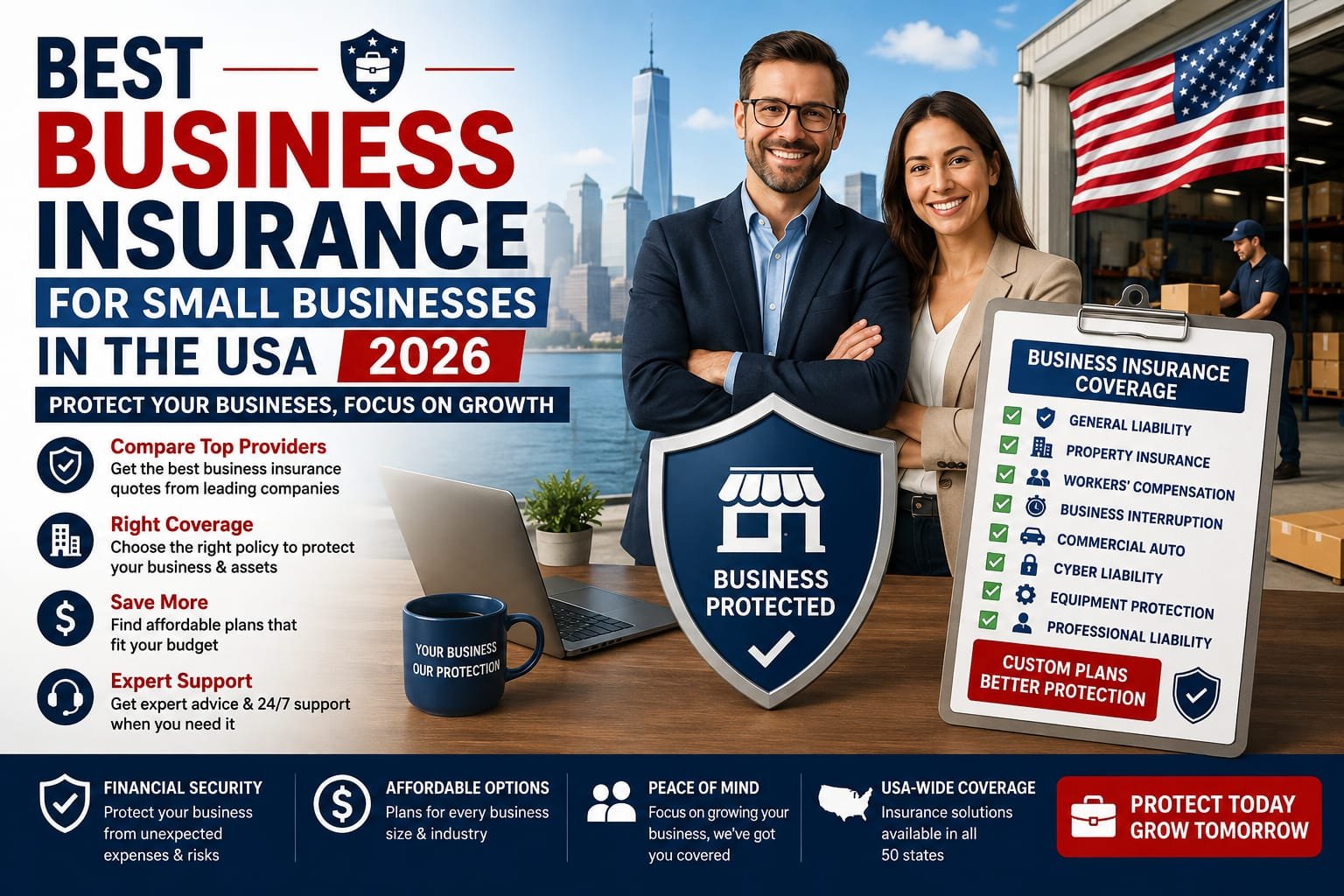
Best Business Insurance for Small Businesses in the USA in 2026
Running a small business comes with risks ranging from customer injuries and lawsuits to property damage, employee accidents, cyberattacks and business interruptions. The right insurance can help prevent one unexpected event from becoming a major financial setback.
There isn’t one insurance policy that is automatically best for every business. The right combination depends on your industry, location, revenue, employees, property, vehicles, customers and specific risks. The U.S. Small Business Administration recommends insuring against risks that the business could not reasonably afford to pay for itself.
🏆 Best Small Business Insurance Companies in 2026
Based on 2026 comparisons and the insurers’ current offerings:
Provider Best for Key strengths
The Hartford Best overall Broad small-business coverage, BOP, workers’ comp
Progressive Commercial auto Business auto and multiple business policies
Travelers Established businesses Broad industry and risk-management capabilities
Hiscox Microbusinesses Online quotes and professional-service coverage
Chubb Higher-risk/growing businesses Broad BOP and industry-specific coverage
Allstate Customer-service-focused buyers Broad small-business options
A 2026 comparison from Business.com similarly selected The Hartford as its overall pick, Progressive for commercial auto, Travelers for high-value businesses, Hiscox for microbusinesses and Chubb for high-risk businesses.
⸻
- The Hartford — Best Overall
The Hartford Small Business Insurance
The Hartford is a strong starting point for many small businesses because it offers a broad range of coverages, including general liability, BOP, workers’ compensation, professional liability, commercial auto, property and cyber coverage.
Potentially good for:
- Restaurants
- Retail businesses
- Consultants
- Contractors
- Technology businesses
- Professional services
- Home-based businesses
The Hartford currently reports average premiums among its customers of about $141/month for a BOP, $68/month for general liability and $62/month for professional liability, although actual premiums depend heavily on the business and policy.
Why consider it: Broad coverage and a strong small-business focus.
⸻
- Progressive — Best for Commercial Auto
Progressive Business Insurance
Progressive is particularly worth considering when vehicles are an important part of your business.
Its business-insurance offerings include:
- Business owners policies
- Commercial auto
- General liability
- Professional liability
- Other business coverages
Best for:
- Contractors
- Delivery businesses
- Service businesses
- Businesses with company vehicles
- Small fleets
⸻
- Travelers — Best for Broad Business Coverage
Travelers Small Business Insurance
Travelers provides small-business coverage across numerous industries, including technology, professional services, healthcare, food and beverage, retail and personal care.
Its BOP can combine property and general liability protection, with additional coverage available depending on the business.
Travelers also emphasizes risk-control and claims-management services, which can be valuable for businesses trying to reduce losses rather than simply pay claims afterward.
⸻
- Hiscox — Best for Microbusinesses and Professional Services
Hiscox Small Business Insurance
Hiscox is particularly attractive for smaller professional and service businesses.
It offers online quoting and coverage options for businesses that:
- Provide professional advice
- Use computers/equipment
- Store sensitive information
- Work from home
- Have employees
- Own or lease commercial property
Good for:
- Consultants
- Freelancers
- IT professionals
- Marketing agencies
- Photographers
- Designers
- Web developers
- Other professional services
⸻
- Chubb — Best for Growing or Higher-Risk Businesses
Chubb Small Business Insurance
Chubb offers a broad small-business insurance portfolio, including BOP and workers’ compensation.
Its BOP can cover businesses across industries such as:
- Contractors
- Food services
- Healthcare
- Manufacturing
- Real estate
- Retail
- Technology
- Wholesale
Chubb says its BOP can serve eligible businesses with revenue of up to $30 million, although eligibility varies by business class and risk.
Best for: Businesses that need more sophisticated or customizable commercial coverage.
⸻
- What Is a Business Owner’s Policy (BOP)?
A Business Owner’s Policy, commonly called a BOP, is one of the most useful insurance packages for many small businesses.
A typical BOP combines:
- General liability
- Commercial property
- Business income/interruption coverage
The National Association of Insurance Commissioners describes a BOP as a package generally combining property, business interruption/continuation and liability coverage.
Example
Imagine you own a small restaurant.
A kitchen fire damages your equipment and forces you to close temporarily.
A properly structured BOP could potentially help with:
- Covered property damage
- Equipment
- Inventory
- Certain liability claims
- Lost business income
- Certain extra expenses during the shutdown
Exact coverage depends on the policy wording, limits, exclusions and endorsements.
⸻
- General Liability Insurance
General liability insurance is one of the most fundamental coverages for small businesses.
It can protect against covered third-party claims involving:
- Bodily injury
- Property damage
- Personal injury
- Advertising injury
- Legal defense
- Settlements or judgments, subject to policy terms and limits
For example:
A customer visits your store, slips on a wet floor and gets injured.
Without insurance, your business could potentially be responsible for medical expenses and legal costs.
The SBA identifies general liability as a common type of business insurance for businesses generally.
⸻
- Professional Liability / Errors & Omissions
Professional liability is particularly important for businesses that provide advice, expertise, designs or professional services.
It can address certain claims alleging that your professional work caused a client financial loss.
Examples include:
- Consultants
- Accountants
- IT companies
- Marketing agencies
- Architects
- Engineers
- Software professionals
- Designers
A general liability policy does not automatically replace professional liability coverage.
⸻
- Workers’ Compensation Insurance
If you have employees, workers’ compensation is one of the most important coverages to investigate.
It generally provides benefits related to covered workplace injuries or illnesses, including medical care and wage replacement.
Requirements vary by state, employee count and business circumstances. The NAIC notes that workers’ compensation requirements vary among states.
Don’t assume that a BOP includes workers’ compensation.
Workers’ compensation is generally purchased separately.
⸻
- Commercial Auto Insurance
If your business owns or regularly uses vehicles for business activities, commercial auto insurance may be necessary.
Examples:
- Delivery van
- Contractor truck
- Company car
- Landscaping vehicle
- Food truck
- Service vehicle
Personal auto insurance may not provide the protection you expect for business use.
The NAIC specifically notes that business-owned vehicles generally require commercial vehicle coverage.
⸻
- Commercial Property Insurance
Commercial property insurance can protect business property against covered losses.
It may cover items such as:
- Building
- Furniture
- Equipment
- Computers
- Inventory
- Tools
- Business contents
Coverage depends on the policy and the cause of loss.
For example, a retailer could have thousands of dollars invested in inventory and equipment. A serious covered property loss could threaten the business without appropriate insurance.
⸻
- Business Interruption Insurance
Imagine a fire forces your business to close for two months.
Your expenses may continue even though revenue stops.
You may still have:
- Rent
- Payroll
- Loan payments
- Utilities
- Other fixed expenses
Business-income/interruption coverage can help replace certain lost income and extra expenses following a covered event. The Insurance Information Institute notes that BOPs commonly include business-income coverage.
⸻
- Cyber Insurance
Cyber insurance is increasingly important in 2026, especially for businesses that store customer or employee information.
Potential exposures include:
- Data breaches
- Ransomware
- Hacking
- Stolen personal information
- Business interruption caused by cyber incidents
- Cyber-related liability
A standard BOP shouldn’t automatically be assumed to provide comprehensive cyber coverage. The NAIC specifically identifies cyber liability as a separate coverage that businesses may need.
For businesses handling sensitive customer information, cyber coverage deserves serious consideration.
⸻
- Product Liability Insurance
If your business manufactures, distributes, wholesales or sells products, product liability can be important.
For example:
A customer purchases a product from your company and claims it caused an injury.
Product-liability coverage may help with covered claims, depending on the policy.
The SBA identifies product liability as a key coverage for businesses involved with physical products.
⸻
- Commercial Umbrella Insurance
Umbrella insurance provides additional liability protection above certain underlying policies.
For example:
You have:
$1 million general liability limit
and purchase:
$2 million umbrella coverage
You may potentially have additional protection above the underlying policy limits, subject to the umbrella’s terms.
The NAIC notes that commercial umbrella limits commonly range from $1 million to $5 million and may be appropriate for businesses with substantial assets or elevated lawsuit exposure.
⸻
- How Much Does Small Business Insurance Cost in 2026?
There is no universal price.
Your premium can depend on:
- Industry
- Location
- Revenue
- Number of employees
- Payroll
- Claims history
- Coverage limits
- Deductible
- Property value
- Vehicles
- Business operations
- Cyber exposure
A July 2026 MoneyGeek analysis found national averages of approximately:
Coverage Average monthly cost
General liability $123
BOP $221
Commercial auto $152
Workers’ compensation $99 per employee
These figures are benchmarks for a small 1–4 employee business, not quotes.
The Hartford’s own customer data is lower for some individual coverages, illustrating why comparing actual quotes is more useful than relying on national averages.
⸻
- What Determines Your Insurance Premium?
Industry risk
A construction company generally faces different risks from an online marketing consultant.
Location
Insurance costs can vary by state and location because of regulations, weather exposure, litigation environment and other factors.
Number of employees
More employees can increase workers’ compensation exposure.
Revenue
Higher revenue can mean greater exposure and potentially higher premiums.
Claims history
Businesses with previous claims may receive different pricing.
Coverage limits
Higher limits generally cost more.
Deductible
A higher deductible can sometimes reduce the premium, but it means the business takes on more cost when a covered claim occurs.
⸻
- What Insurance Does a Small Business Actually Need?
There is no single answer.
🧑💻 Online consultant
Potential coverage:
- General liability
- Professional liability
- Cyber insurance
- BOP, depending on property exposure
🏪 Retail store
Potential coverage:
- BOP
- General liability
- Commercial property
- Business income
- Workers’ compensation
- Cyber insurance
- Commercial auto if applicable
🍔 Restaurant
Potential coverage:
- BOP/commercial package
- General liability
- Property
- Business income
- Workers’ compensation
- Commercial auto if delivery vehicles are used
- Cyber
- Product/food-related liability
🔨 Contractor
Potential coverage:
- General liability
- Commercial auto
- Workers’ compensation
- Tools/equipment coverage
- Professional liability where applicable
- Umbrella
- Builders risk for appropriate projects
💻 Technology startup
Potential coverage:
- General liability
- Professional liability/E&O
- Cyber liability
- Business property
- Workers’ compensation
- Employment practices liability
- Directors & officers coverage as appropriate
⸻
- Business Insurance Comparison
Insurance Main purpose Who should consider it?
General Liability Third-party injury/property claims Almost every business
BOP Liability + property + business income Many small businesses
Professional Liability Professional errors/negligence Consultants/service firms
Workers’ Comp Employee workplace injuries Businesses with employees
Commercial Auto Business vehicle risks Businesses using vehicles
Property Business property Businesses with physical assets
Cyber Cyber/data risks Businesses handling digital data
Product Liability Product-related claims Sellers/manufacturers
Umbrella Extra liability limits Higher-risk/asset-rich businesses
Business Income Lost income after covered interruption Businesses dependent on physical operations
⸻
- How to Choose the Best Insurance
Don’t simply choose the insurer with the lowest premium.
Compare:
- Coverage
Does the policy actually protect against your major risks?
- Limits
Are the liability limits sufficient?
- Deductibles
How much would your business have to pay before insurance responds?
- Exclusions
What isn’t covered?
- Endorsements
Can you add industry-specific coverage?
- Claims service
How does the insurer handle claims?
- Financial strength
Consider the insurer’s ability and reputation for paying covered claims.
- Price
Finally, compare premiums after making sure you’re comparing similar coverage.
⸻
- How to Save Money on Business Insurance
You don’t necessarily need to buy the cheapest policy.
Instead:
- Compare several insurers
- Bundle eligible coverages
- Ask about risk-management discounts
- Improve workplace safety
- Use cybersecurity controls
- Review coverage annually
- Avoid unnecessarily high limits or unnecessary coverage
- Consider a higher deductible if your business can comfortably afford it
- Keep accurate payroll and business records
- Maintain a good claims history
Insurance costs are affected by risk, so reducing the underlying risk can sometimes help.
⸻
- What Is a Certificate of Insurance (COI)?
A Certificate of Insurance, or COI, is a document showing evidence of insurance coverage.
A landlord, client, general contractor or event organizer may ask your business for a COI.
For example:
“Please provide a certificate showing $1 million general liability coverage.”
The COI is evidence of insurance; it does not replace the actual insurance policy.
⸻
- Is Business Insurance Required?
It depends.
Some insurance is legally required depending on:
- State
- Employees
- Industry
- Vehicles
- Contracts
- Professional licensing
Workers’ compensation is a major example where state requirements apply to many employers.
Even when insurance isn’t legally required, a landlord, customer, lender or contracting partner may require it as part of a business agreement.
The SBA recommends checking federal, state and local requirements and discussing appropriate coverage with insurance professionals.
⸻
- Business Insurance in 2026: Important Cost Trend
Insurance costs are not moving uniformly across every category.
A 2026 Kiplinger business-cost report expects primary general liability and umbrella/excess liability costs to increase roughly 5%–20%, while cyber insurance pricing can vary considerably based on security controls and claims history.
That makes it particularly important for small businesses to:
- Review policies annually
- Compare quotes
- Improve cybersecurity
- Update property values
- Report changes in employees/revenue
- Reassess coverage limits
⸻
- Best Business Insurance by Business Type
Business Strong starting point
Freelancer General liability + professional liability
Consultant Professional liability + general liability
IT company Professional liability + cyber + general liability
Retail store BOP + workers’ comp + cyber
Restaurant BOP/package + workers’ comp + auto if needed
Contractor General liability + workers’ comp + commercial auto
E-commerce General/product liability + cyber + property
Photographer General liability + equipment/property
Real-estate business General liability + professional liability
Tech startup General liability + E&O + cyber + employment-related coverage
Delivery company Commercial auto + general liability + workers’ comp
Manufacturing Commercial package + product liability + workers’ comp
⸻
- Final Verdict: Which Is Best in 2026?
🥇 Best overall: The Hartford
A strong all-around choice for many small businesses because of its broad coverage options and focus on small-business customers.
🚚 Best for commercial auto: Progressive
Particularly worth comparing if vehicles are central to your operations.
🏢 Best for established/growing businesses: Travelers
A broad industry footprint plus risk-control resources makes it worth considering for businesses with more complex needs.
👨💻 Best for microbusinesses: Hiscox
Especially attractive for many professional-service and very small businesses seeking online purchasing options.
🏭 Best for complex/high-risk businesses: Chubb
Its broad BOP and industry-specific offerings can be useful for businesses with more sophisticated insurance requirements.
Bottom Line
For most small businesses, general liability is the foundation, while a BOP can be a practical starting point when the business also has property and business-income exposure. Businesses may then need workers’ compensation, professional liability, commercial auto, cyber, product liability or umbrella coverage depending on their operations.
The best strategy in 2026 is not to buy the cheapest policy—it’s to compare several quotes with equivalent limits and make sure the coverage matches the risks your business actually faces.
Insurance products, availability, legal requirements, premiums and coverage terms vary by state and insurer. This is general educational information, not individualized insurance or legal advice.